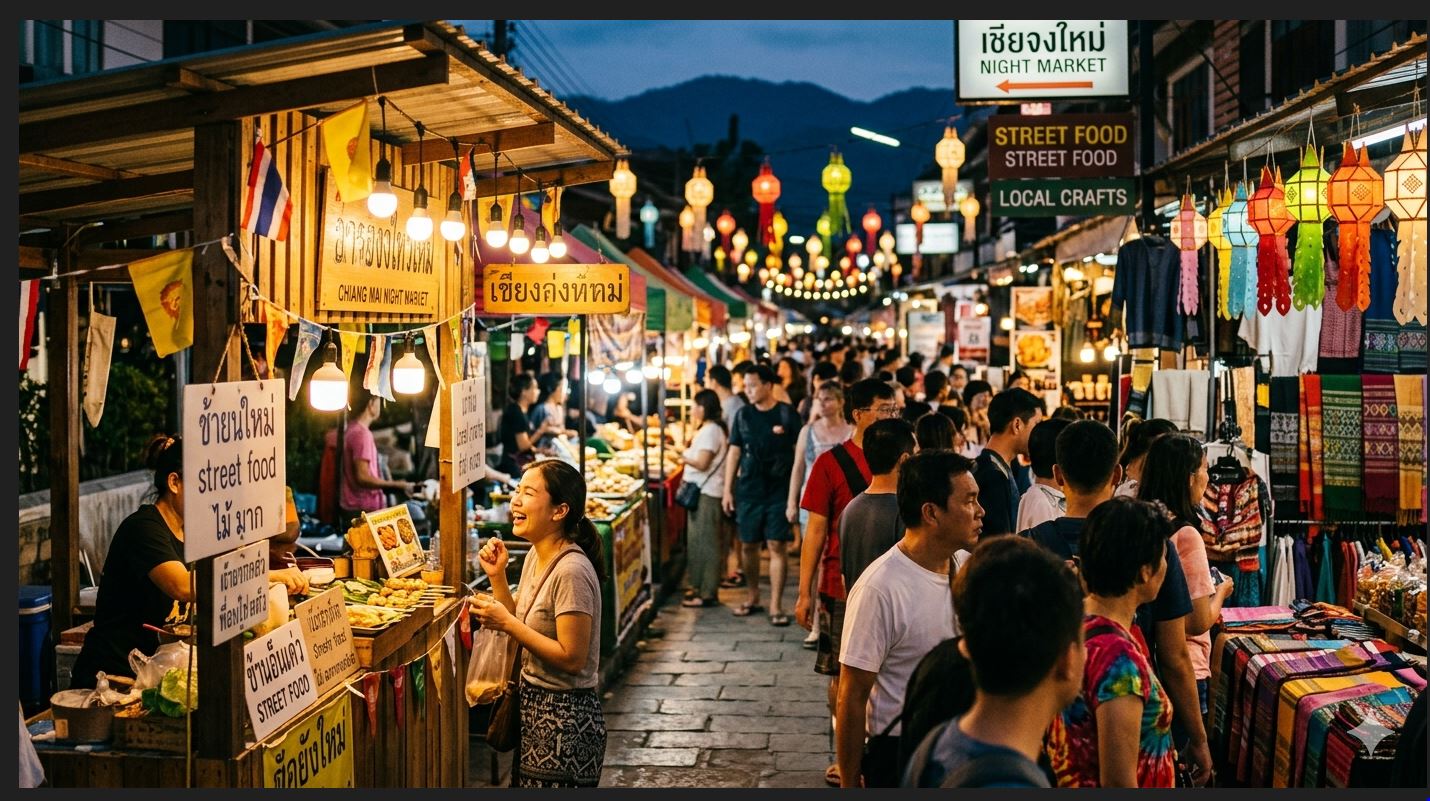
If you're only spending a weekend in Chiang Mai, you'll likely end up choosing between the city's two biggest weekly events: the Saturday Walking Street on Wua Lai Road and the Sunday Walking Street on Ratchadamnoen Road. Both close entire streets to traffic, both fill up fast, and both are genuinely worth experiencing — but they have distinct personalities, and picking the right one (or both, if your schedule allows) makes a real difference to your evening.
The Saturday Walking Street (Wua Lai Road)
Located just south of the Old City walls, this market runs down Wua Lai Road — traditionally the silversmithing district of the city. That heritage still shows: this is the best place in Chiang Mai to find handmade silver jewelry, hammered bowls, and intricately worked metal pieces sold directly by the families who craft them, a tradition passed down for generations in this particular neighborhood.
Physically, Wua Lai is narrower and more tightly packed than the Sunday market. The stalls sit closer together, the crowd feels more concentrated, and the overall energy is a little more intense and local. Because it's smaller in footprint, it's also more manageable if you only have an hour or two — you can walk the full length without the marathon feel that Sunday's market can have. Alongside the silverwork, expect handmade clothing, leather goods, and a solid lineup of southern and northern Thai street food stalls filling the side lanes.
Wat Sri Suphan — Chiang Mai's famous "Silver Temple" — sits directly along the market route and is worth the short detour. Its facade, entirely covered in hammered silver and aluminum panels depicting Buddhist stories, is genuinely striking when lit up at night, and it ties the whole street's silversmithing identity together in a way that's easy to miss if you're only there to shop.
The Sunday Walking Street (Ratchadamnoen Road)
Starting at the historic Tha Phae Gate, this market cuts right through the absolute center of the Old City. It's the largest market in Chiang Mai, stretching over a kilometer long, and it draws by far the biggest crowd of the week — locals, expats, and tourists all converge on Ratchadamnoen Road once the road closes to traffic in the afternoon.
Because the street is wider and runs directly past several of Chiang Mai's most beautiful temples, it offers some of the best photo opportunities of any market in the city — particularly Wat Phra Singh near the western end, where the temple courtyard fills with food vendors and the illuminated chedi provides a genuinely memorable backdrop. The scale here means a much broader range of goods: handmade textiles, ceramics, original artwork, clothing, and an enormous stretch of open-air temple food courts serving everything from northern curries to fresh mango sticky rice. Live music and cultural performances pop up at several points along the route, adding to the festival-like atmosphere.
The tradeoff for all that scale is crowding. By early evening, the main stretch near Tha Phae Gate can be genuinely difficult to move through, and the full experience — walking both directions, ducking into the side alleys like Soi Rommanee — realistically takes two to three hours if you want to do it properly.
So Which One Should You Choose?
If your priority is jewelry, silver craftsmanship, and a slightly calmer, more concentrated market experience, Saturday on Wua Lai Road is the better fit — especially if you're short on time or prefer browsing without fighting through dense crowds.
If your priority is scale, atmosphere, temple photography, and the widest possible selection of food and crafts, Sunday on Ratchadamnoen Road is the one to prioritize. It's also simply the more iconic of the two — if you can only make it to one Chiang Mai walking street during your trip, this is generally the one locals and repeat visitors point newcomers toward.
If your schedule allows for both, there's no real downside to doing so — the two markets are different enough in character that visiting on consecutive nights doesn't feel repetitive. Arrive by 5:00 PM on either night to beat the thickest crowds and still catch the vendors at their freshest, and bring cash — both markets, like nearly all street markets in Thailand, run overwhelmingly on cash rather than cards.