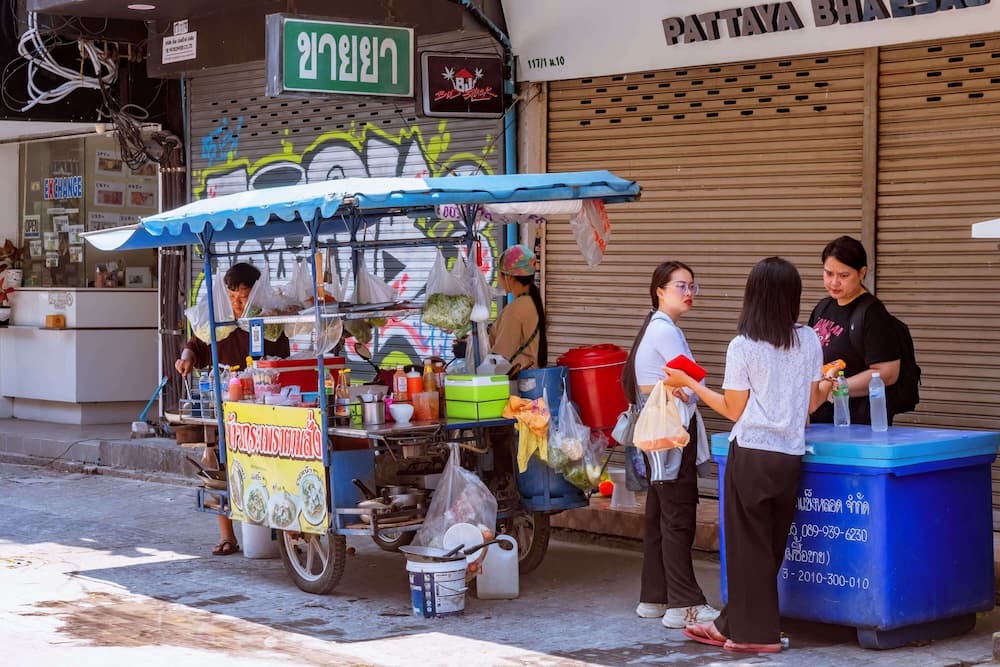
Phuket's night markets exist, fundamentally, because of the food. The shopping is secondary. The live music is atmosphere. But the food — the open flames, the sizzling woks, the steaming bowls, the bright mango cut at the counter while you wait — is the reason people who visit once come back every evening for the rest of their trip. If you're new to Phuket's market scene and not sure what to order, this checklist covers everything worth trying, from the dishes you'll find at every market on the island to the Phuket-specific specialties that don't exist anywhere else.
Dishes You'll Find at Every Market
Moo Ping (Grilled Pork Skewers) The smell alone will find you before the stall does. Pork shoulder marinated in garlic, coriander root, fish sauce, and palm sugar, skewered on bamboo sticks and grilled over charcoal until the edges caramelize. Eaten with sticky rice. Cost: 10–20 baht per skewer. Available at literally every night market in Phuket, from OTOP in Patong to Naka in Phuket Town.
Pad Thai The dish every international visitor orders first and every Thai resident takes for granted. At its best in a night market setting — cooked to order in a single-serving wok with rice noodles, egg, bean sprouts, green onion, and your choice of protein, then finished with crushed peanuts, dried chili, and a wedge of lime. Cost: 60–100 baht. The versions at Naka Market and Chillva are consistently good.
Mango Sticky Rice (Khao Niaow Ma Muang) The unofficial dessert of Phuket's night markets. Glutinous rice cooked in sweetened coconut milk, served warm alongside chilled fresh mango and a drizzle of extra coconut cream. The contrast of temperatures and textures — warm, starchy, cold, sharp, creamy — is one of those combinations that makes immediate sense. Cost: 60–100 baht. Found at every market; the fruit stalls at Kata Night Market are particularly reliable.
Som Tam (Green Papaya Salad) Shredded unripe papaya pounded in a mortar with dried shrimp, cherry tomatoes, green beans, chili, palm sugar, fish sauce, and lime. Loud, bright, sour, spicy, and completely addictive. Ask for "mai pet" if you want it mild. Cost: 50–80 baht. Any market with an Isaan food stall will have a version; Naka Market has some of the island's best.
Grilled Seafood Phuket is an island. The seafood at its best night markets reflects that. Whole fish grilled over charcoal with lemongrass stuffing, tiger prawns butterflied and cooked over open flame, squid cut into rings and charred until just done, and mussels steamed in coconut broth are all common sights. Choose your seafood from the displayed ice tray, agree on a price, and watch it cook. Cost varies significantly by type and size — budget 150–300 baht for a proper seafood plate.
Phuket-Specific Dishes Worth Hunting For
A-Pong (Phuket Crispy Coconut Crepe) A southern Thai street snack that's been made in Phuket for generations. Thin batter poured into small cast-iron molds over a charcoal fire produces a crispy, lacey-edged crepe with a soft center, eaten plain or with a drizzle of sweetened coconut cream. This is a specifically Phuket specialty — you won't find it in the same form in Bangkok or Chiang Mai. Look for it at Chillva Market and Lard Yai Sunday Walking Street.
Hokkien Noodles (Mee Hokkien) A legacy of Phuket's Chinese immigrant population, these thick yellow wheat noodles are stir-fried in a rich, dark soy-based sauce with pork, squid, greens, and bean sprouts. The dish is fundamentally different from Bangkok noodle styles and distinctly Phuket in character. Available at Lard Yai on Sunday evenings from vendors specializing in Phuket Old Town heritage cooking.
Kanom Jeen (Rice Noodles with Southern Curry) Thin fermented rice noodles served at room temperature, topped with a choice of southern Thai curries — most commonly a rich fish-based yellow curry or a fresh coconut milk green curry — and accompanied by a spread of raw vegetables, pickled greens, and hard-boiled eggs. The southern Thai version of this dish is significantly spicier and more coconut-forward than northern variations. Found at Lard Yai and specialty food stalls at Naka Market.
Fried Insects Not a Phuket specialty specifically, but universally available across the island's markets and consistently memorable for first-time visitors. Crickets, silkworms, grasshoppers, and bamboo worms, all deep-fried until crunchy and seasoned with salt and chili. Chillva Market has some of the island's most theatrical insect stalls — if you're going to try them anywhere, try them there.
Practical Tips for Eating at Phuket Night Markets
- Walk the full circuit before you buy anything. Every experienced market visitor does this. The first stall you see is never the last stall. Complete one full loop to understand what's available, then return to what caught your attention.
- Follow the locals, not the menus. If a stall has a queue of Thai people, the food is almost certainly good. If a stall has a large English menu displayed prominently and no Thais eating, manage your expectations accordingly.
- Eat the fruit. Fresh tropical fruit in Phuket's markets — papaya, pineapple, dragon fruit, rambutan, mangosteen, fresh coconut — is uniformly excellent and extremely cheap. A mixed fruit bag costs 20–40 baht and provides exactly the cooling, refreshing counterpoint a hot market evening needs.
- Drink the coconut water. Fresh young coconuts, opened with a machete and served with a straw, are available at most markets and are the single best hot-weather drink Phuket has to offer. Cost: 30–50 baht.
- Budget realistically. A full evening at a Phuket night market — dinner for one, two or three dishes, a dessert, and a cold drink — should cost between 150 and 300 baht if you're eating at market-priced stalls. If you're spending significantly more than that per person, you've wandered into tourist-facing pricing and can simply move to the next stall.