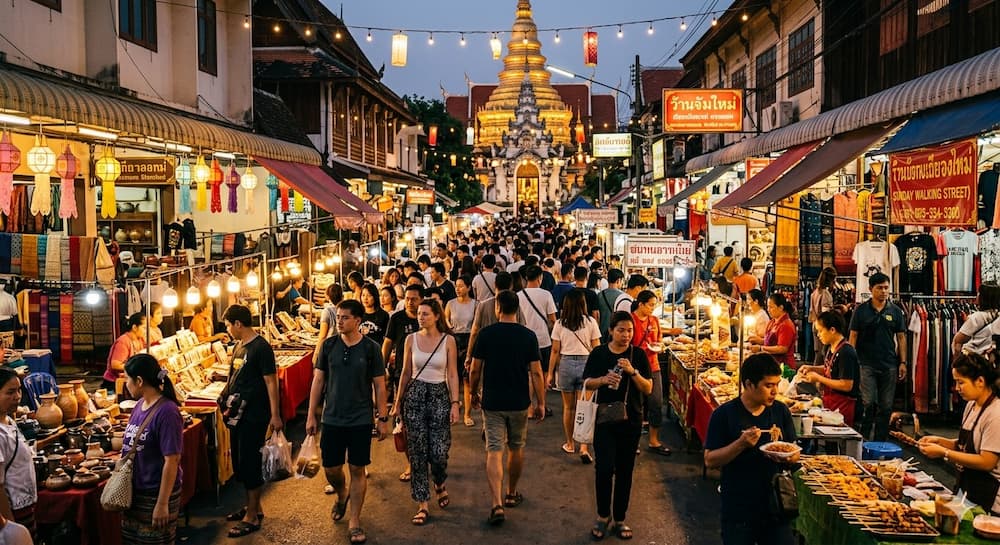
Navigating the bustling Chiang Mai night markets is an essential experience for any tourist visiting Northern Thailand — but the difference between a smooth, enjoyable evening and a frustrating one often comes down to a handful of small things nobody tells you in advance. Keep these five tips in mind and you'll spend your evening actually enjoying the markets instead of troubleshooting your way through them.
1. Cash Is King
Nearly all individual street vendors are cash-only, and this holds true across every market in the city, from the massive Sunday Walking Street down to the smallest neighborhood food stalls. Keep small bills — 20, 50, and 100 baht notes — handy for quick transactions. Most street food purchases run well under 100 baht, so handing over a 500 or 1,000 baht note for a 40-baht skewer is a common source of friction; vendors selling from small carts often don't carry much change, and breaking a large bill can slow down the line behind you. Withdraw cash before you head out for the evening rather than hunting for an ATM once you're inside the market, since machines directly on the walking streets can run out during peak hours or have long queues of their own.
2. Arrive Early to Beat the Crowds
Most markets officially open around 5:00 PM. Arriving by 5:30 PM lets you browse the stalls and eat comfortably before peak crowds hit around 7:00 PM. There's a real, practical advantage to this beyond comfort: vendors are freshest early in the evening, popular dishes haven't sold out yet, and you can actually stop and look at handicraft stalls without being swept along by foot traffic. On Sunday Walking Street especially, the stretch near Tha Phae Gate becomes genuinely dense by 7:30–8:00 PM, and simply crossing from one side of the road to the other can take several minutes. Arriving early also means better light for photos, particularly around temple courtyards where the golden hour and the first strings of market lights overlap.
3. Friendly Bargaining Is Expected — But Only in Certain Places
Gentle negotiation is part of the culture at souvenir and craft stalls, where prices are often set with some room built in specifically for back-and-forth. Keep it light, polite, and always accompanied by a smile — bargaining in Thailand is a social exchange, not a confrontation, and vendors respond far better to a cheerful counteroffer than a hard, aggressive one. A reasonable approach is to offer somewhat below the asking price and settle somewhere in the middle. Food stall prices, by contrast, are strictly fixed — don't attempt to haggle over a bowl of noodles or a skewer of grilled pork, as this is generally considered inappropriate and won't get you anywhere.
4. Watch Out for Pickpockets
Chiang Mai is highly safe for international tourists overall, but crowded, slow-moving areas like packed market streets are prime spots for opportunistic theft anywhere in the world, and Chiang Mai's markets are no exception. Keep bags zipped and secured to your front rather than your back or side, avoid displaying large amounts of cash when paying for something, and be especially mindful in the densest sections of the market where distraction techniques are more effective. None of this should discourage you from visiting — it's simply standard travel practice for any high-density tourist area, and taking a few basic precautions is enough to make it a non-issue.
5. Take Advantage of Foot Massages
After walking down a hot street for hours, look for the open-air foot massage stalls set up directly along the market paths. It's one of the most distinctly Chiang Mai ways to wind down an evening — sitting in a row of reclined chairs right at the edge of the market action, watching the crowds go by while a therapist works out the fatigue from a day of walking. Prices are typically very affordable, often 150–250 baht for a 30–45 minute foot massage, and many stalls also offer neck and shoulder add-ons. It's a genuinely relaxing way to close out a market evening rather than pushing through until you're exhausted, and it fits naturally into the unhurried, browse-eat-relax rhythm that makes Chiang Mai's night markets so enjoyable in the first place.
One More Thing: Pace Yourself
Chiang Mai's markets aren't designed to be rushed. Between the food, the crafts, the temples along the route, and the general atmosphere, trying to see everything in one visit is the fastest way to burn out. Treat your first night market as an orientation — get a feel for the layout, try a few dishes, and note what you want to come back for. If your trip includes more than one evening in Chiang Mai, spreading your market visits across different nights (and different markets, since Saturday's Wua Lai Road and Sunday's Ratchadamnoen Road each have their own character) will leave you with a much better overall impression than trying to do it all in a single exhausting evening.